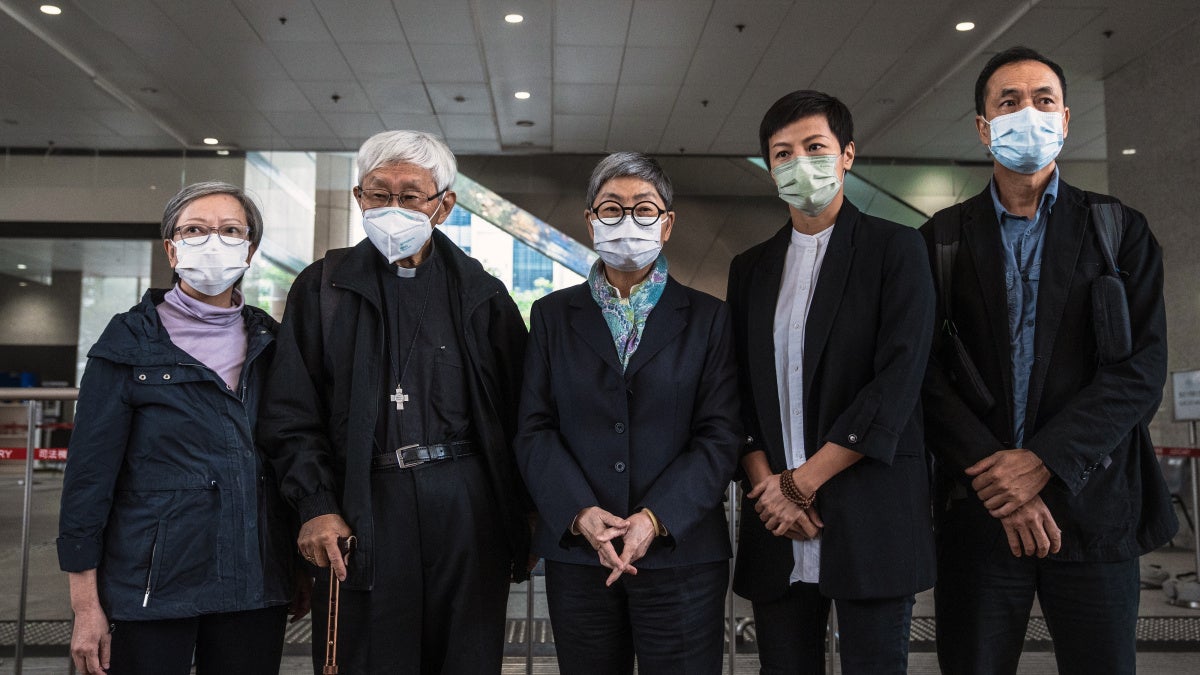
Former trustees of the 612 Humanitarian Relief Fund, following a verdict at the West Kowloon Magistrates' Courts in Hong Kong, November 25, 2022.
Organizing a group to help people in distress used to be something Hong Kong people could do without fear. Not anymore.
On September 3, the Hong Kong Court of Appeal affirmed the conviction of five 612 Humanitarian Fund trustees for failing to register the fund under the Societies Ordinance. It’s just the latest example of the government weaponizing colonial-era laws to dismantle civil society organizations.
The 612 Fund was established in 2019 through public donations to cover medical and legal expenses for demonstrators arrested during the pro-democracy protests. It ceased operations in 2021. The following year, its five trustees—including Cardinal Joseph Zen, the barrister Margaret Ng, and the singer Denise Ho—were fined HK$4,000 (US$510) for failing to register as a society. Separately, they were also arrested under the newly adopted National Security Law for alleged “foreign collusion”; that case remains open.
The ruling has serious rights implications for organizations in Hong Kong. The Societies Ordinance defines “society” so broadly that virtually any informal group can fall within it. To operate legally, a group must provide personal informationto police and meet strict, continuing reporting obligations, allowing authorities to monitor everyday civic activity. Yet the appeals court ruled that these requirements did not impose “an unacceptably harsh burden” on freedom of association.
The ordinance was enacted by the British colonial government in 1911 primarily to control gangs. The United Nations Human Rights Committee and civil society groups have long criticized the law for its vague language and sweeping scope.
In the two decades since the United Kingdom handed sovereignty over Hong Kong to China in
… [more]