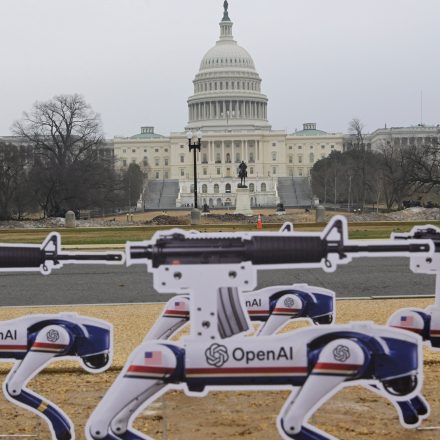
The Department of Defense
asked OpenAI to provide the U.S. military with a special version of its artificial intelligence technology designed to turn down the military commands as infrequently as possible, according to documents obtained by The Intercept.
The desire for a custom AI tool with “minimal refusal rates” to Pentagon commands was revealed in files released to The Intercept as part of a Freedom of Information Act lawsuit seeking information about the military’s secretive deals with AI companies.
AI Giants Work Hand-in-Hand With the Pentagon, Contracts Reveal
OpenAI, along with rivals Google, xAI, and Anthropic, all agreed in 2025 to develop militarized prototypes of their state-of-the-art AI to assist the armed forces in uses including logistics, intelligence decision-making, and general “warfighting.” Earlier this year, the Pentagon sought to expand the scope of these agreements and deploy them across U.S. classified computer networks, resulting in a high-profile
showdown with Anthropic
over whether and how the company could restrain military uses of its technology.
The clause seeking “minimal refusal rates” from OpenAI
appears in an updated contract — version “P00003”
— expanding upon last summer’s prototype deal, worth up to $200 million over the contract’s two-year duration.
A separate document
, signed by both OpenAI and the government on February 6, indicates that OpenAI agreed on that day to the contents of an expanded version “P00003.”
OpenAI and the Pentagon deny agreeing to such “minimal refusal ” language, claiming that the “P00003” document provided to The Intercept was a draft and not the final version. “OpenAI has never agreed to contract language requiring ‘minimal refusal rates.’ This language does not appear in our executed contract,” said spokesperson Nate Evans.
“The document you received appears to be an earlier draft proposed by the Department before we provided feedback. We rejected that language, the
… [more]