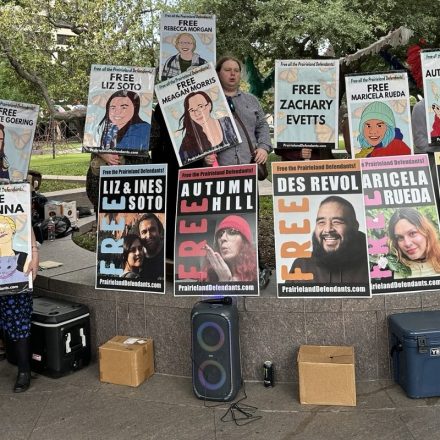
On the last
day of the Prairieland trial, in which nine Texas protesters were accused of crimes including providing
material support to terrorists
, the attorney for activist Benjamin Song presented a novel argument that, if true, would have upended the federal government’s case.
Song had been charged with attempted murder for allegedly firing a gun at the first police officer who arrived on the scene after a noise demonstration outside U.S. Immigration and Customs Enforcement’s Prairieland Detention Center in Alvarado on July 4, 2025.
The defense — more than a dozen attorneys representing clients with varying degrees of involvement in the protest — had rested their argument without calling a single expert witness, owing to what they thought was the weakness of the government’s case.
“Attempted murder requires that you intend to kill. And if the government can’t prove that intent, that’s a not guilty — period.”
During closing arguments, however, Phillip Hayes, Song’s attorney, raised what he said was a major flaw in the government’s depiction of what happened: Song never aimed his weapon at the police officer. Relying on evidence introduced by the prosecution — a photograph of the bullet, witness testimony, and CCTV footage of the incident — Hayes said his client never intended to shoot Alvarado Police Department Lt. Thomas Gross.
Rather, Hayes said, Song fired his weapon at the ground and the bullet ricocheted off a hard surface before striking the officer just below the neck. That would explain the plumes of dust that were visible in the video. According to Hayes, the only photo of the bullet, which appears severely bent and with several missing fragments, backs up the theory.
“Attempted murder requires that you intend to kill,” Hayes, a lanky, soft-spoken criminal defense attorney, told the jury on March 11. “And if the government can’t prove that intent, that’s a not guilty — period.”
The jury didn’t bite. Instead of being acquitted, Song was con
… [more]

