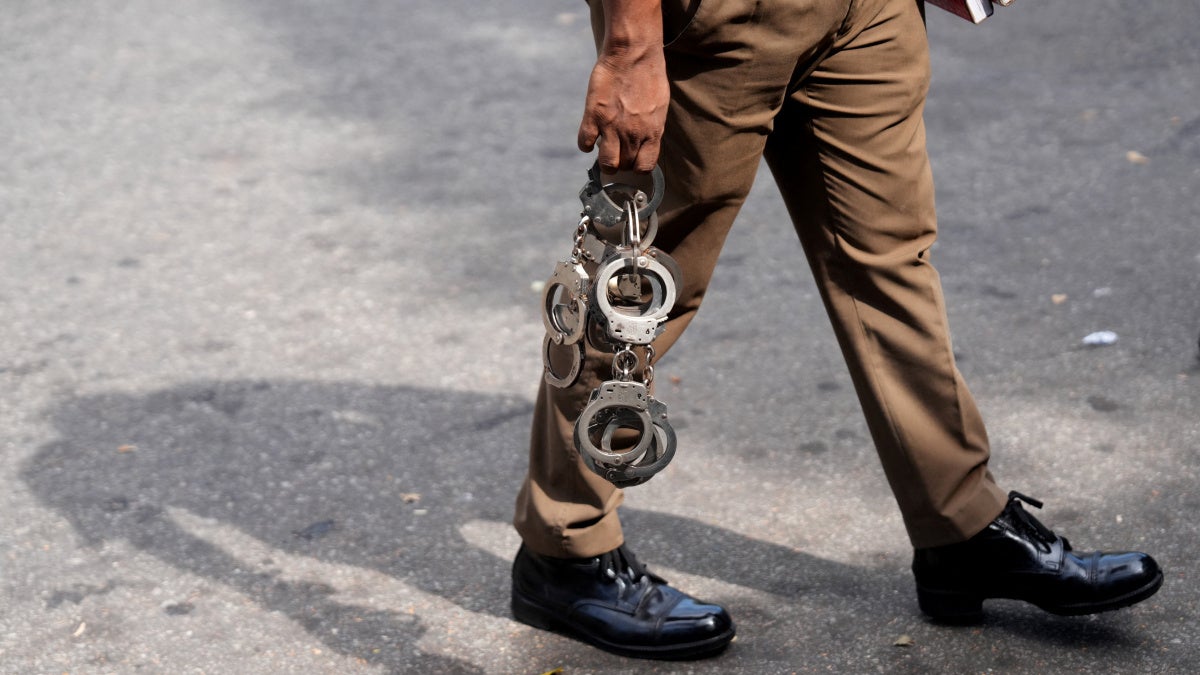
A police officer holds handcuffs as he walks inside a court premises in Colombo, Sri Lanka, August 6, 2026.
(Brussels) – The Sri Lankan government’s latest attempt to replace its abusive Prevention of Terrorism Act (PTA) retains numerous provisions that have enabled serious human rights violations, Human Rights Watch said today.
The proposed Protection of the State from Terrorism Bill (PSTB), which will be sent to Parliament on October 6, 2026, includes an overbroad definition of terrorism, inadequate judicial oversight, sweeping powers of search and arrest for the armed forces, and executive authority to curtail freedom of speech, assembly, association, and movement. These provisions neither meet the benchmarks set out by United Nations human rights experts, nor comply with human rights obligations and commitments that Sri Lanka made to the European Union under the Generalized System of Preferences (GSP+), which links trade benefits to human rights conditions.
“Sri Lankan authorities have long used draconian counterterrorism legislation to persecute minorities and target the victims of rights abuses and activists seeking justice and accountability,” said Elaine Pearson, Asia director at Human Rights Watch. “The proposed law will allow similar abuses, breaching Sri Lanka’s obligations under international law and jeopardizing its EU trade benefits.”
President Anura Kumara Dissanayake’s National People’s Power alliance pledged in its 2024 election manifesto to campaign for the abolition “of all oppressive acts including the Prevention of Terrorism Act (PTA) and ensuring civil rights of people in all parts of the country.” The bill is the proposed replacement for the PTA, which has enabled arbitrary detention, ill-treatment, and torture.
That law—first enacted in 1979 as a “temporary” measure—has been used to target Tamil and Muslim communities, the media,