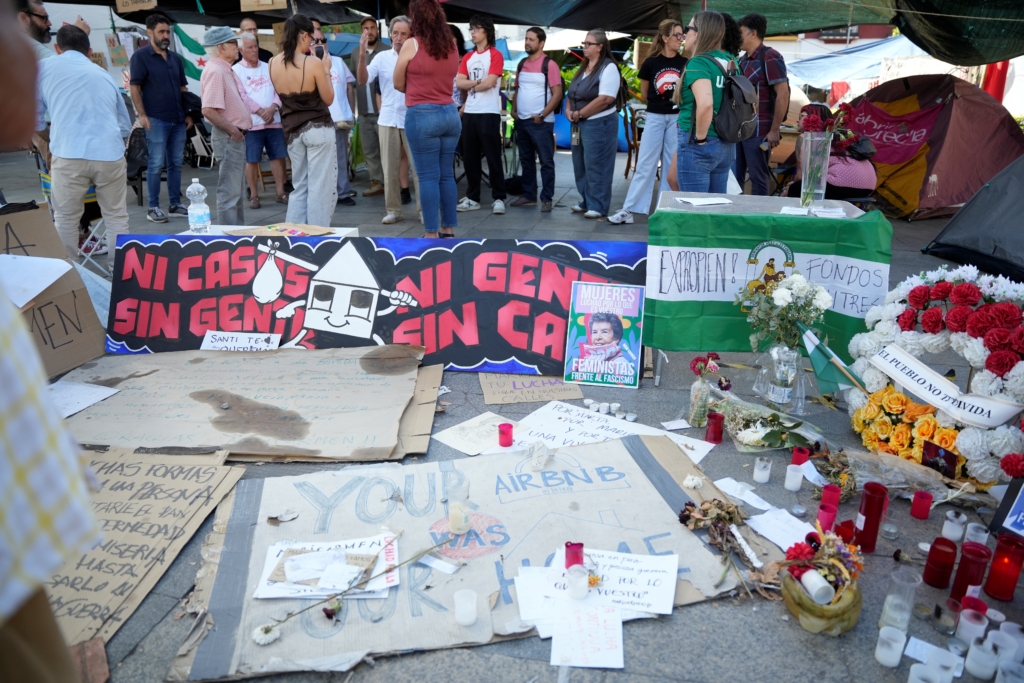
Almost two months after the eviction of Maricarmen, the 87-year-old woman whose subsequent death sparked a movement, Spain’s housing encampments demanding change remain steadfast. Sofía Guerrero Orte, Alberto Pérez Madrona and Pablo Rodríguez Rodríguez, three university students involved in Seville’s encampment since the beginning, explain how the movement has grown and triggered an election, becoming the driving force behind Spain’s first general strike in 14 years.
“These young people today… they don’t protest like they used to…” They call us the “generación de cristal” or the “Glass Generation”. They say we are fragile, but here we are protesting and resilient – because when glass breaks it cuts.
To many on the outside it may have looked like the Spanish housing protests happened overnight – an outpouring of grief and rage following Maricarmen’s eviction in September. But the lack of affordable housing has long suffocated students, young people, elderly people, single mums and marginalized populations, such as racialized groups – those of us who are already at higher risk of social exclusion.
The heartbreaking sight of Maricarmen, an 87-year-old woman who could have been your own grandmother, being evicted from her home and carried out on a stretcher – that, that was the moment when we collectively said “enough!”. And that’s when everything that we housing campaigners had been building for years – association networks, workshops, talks and activities to raise awareness and connect people – finally came together
The encampments started in Madrid, and the rest of the cities followed suit. Everyone was watching the news waiting to see what would happen to the housing decree (a decree that had been gathering dust in a drawer for years to suddenly be issued urgently). But then there was no parliamentary majority, and just like the butterfly effect, an eviction – among so many in Spain, and so many that people are trying to stop – ended up triggering an earl
… [more]

