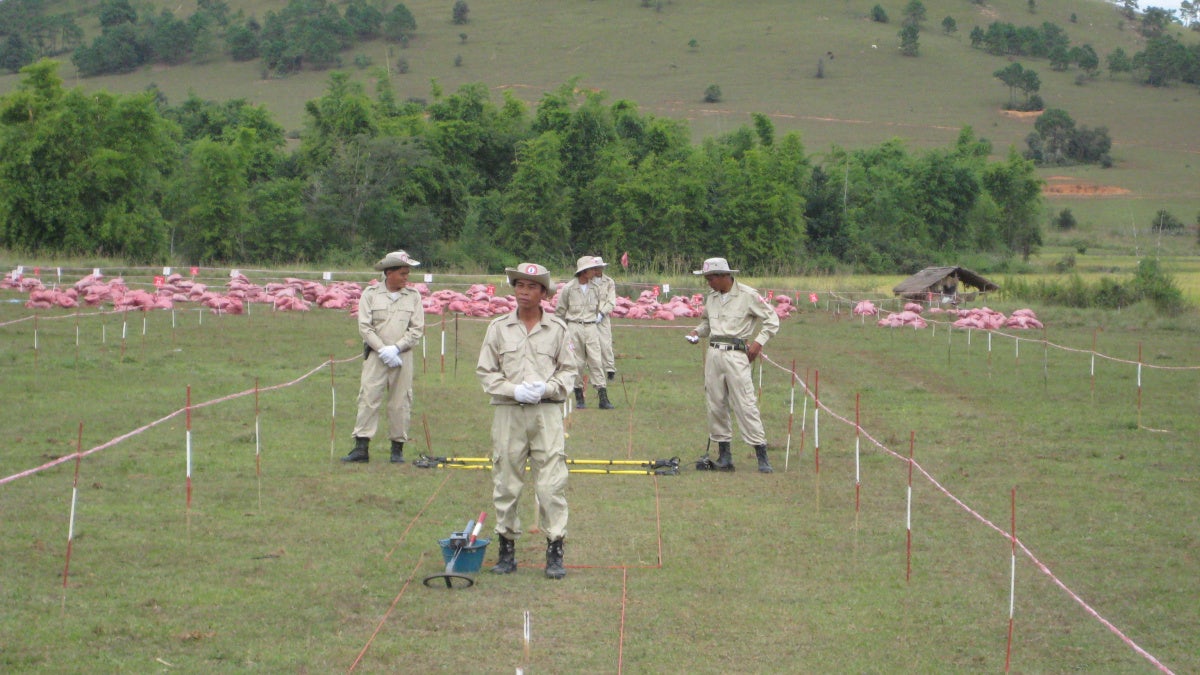
Red sandbags cover unexploded submunitions awaiting destruction near a school in Xiang Khouang Province, Laos.
Cluster munitions killed or injured at least 1,063 people globally in 2025. This figure is among the highest annual totals recorded by the Cluster Munition Coalition in its annual Cluster Munition Monitor. Cluster munitions typically disperse multiple explosive submunitions over a wide area. Many fail to explode on initial impact, leaving unexploded duds that can indiscriminately injure and kill like landmines for years, until they are found and destroyed.The 124 countries that are members of the Convention on Cluster Munitions at its review conference on September 14-18, 2026, should condemn the production, sale, transfer, and use of cluster munitions by other countries.
(Washington, DC, September 8, 2026) – An increase in civilian deaths and injuries caused by cluster munitions should trigger united action among the 124 countries that are members of the Convention on Cluster Munitions, Human Rights Watch said today on the release of the “Cluster Munition Monitor 2026” by the Cluster Munition Coalition. Human Rights Watch is a founding member of the coalition and contributed to the report.
The 150-page report assesses all countries’ adherence to the 2008 convention. Cluster munitions killed or injured at least 1,063 people globally in 2025. This figure is among the highest annual totals recorded by the Cluster Munition Coalition. The actual number is most likely higher as many casualties go unreported. New casualties were recorded in nine countries in 2025: Afghanistan, Cambodia, Iraq, Laos, Lebanon, Myanmar, Russia, Syria, and Ukraine. Cluster munitions continued to disproportionately affect civilians, whether from direct attacks or the remnants they leave behind. Civilians accounted for 87 percent of casualties recorded for 2025, where the ci