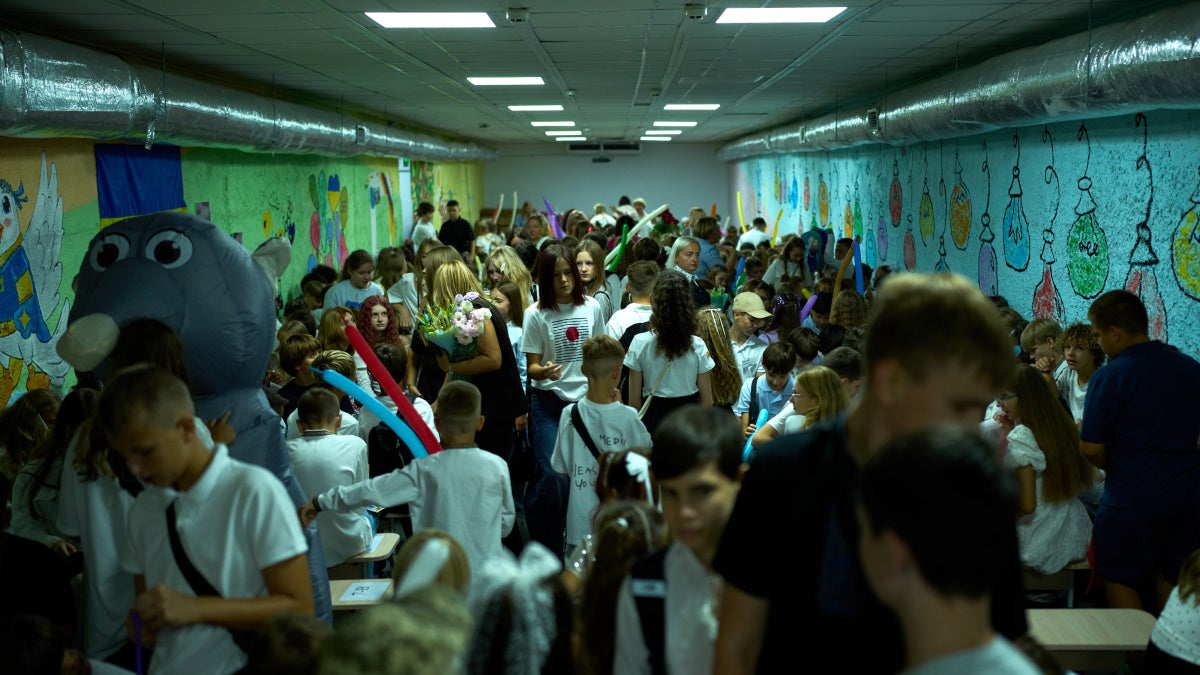
Children, parents, and teachers shelter underground during an air raid alert amid traditional back-to-school celebrations in Kyiv, Ukraine, September 1, 2026.
As schools in Ukraine opened for the new academic year on September 1, repeated air raid alerts in Kyiv and elsewhere have disrupted classes and sent children into shelters, sometimes for hours.
On September 3, Olya’s daughter managed to complete just one lesson – math –before alerts sent her fourth-grade class into a cramped underground shelter.
“The shelter is not equipped for studying,” said Olya, who, like others interviewed, asked to be identified by their first name, showing me a photo of the children squeezed together underground. “Even if they [teachers] wanted to continue classes, they wouldn’t be able to. It’s too noisy.”
Other subjects were assigned as homework. The children also had virtually no breaks: when an alert ended, they rushed back to the classroom to make up lost lesson time.
Recently, air raid alerts have sounded in Kyiv as many as 10 times a day, for more than five hours on some days.
Even schools with shelters equipped for classes struggle to maintain normal learning. Ira’s daughter attends a school in central Kyiv and finds shelter lessons stressful. “She cannot hear the teacher properly,” Ira said. “And there are too many people in one small space.”
Little is normal about childhood in wartime, and school is no exception. Ukrainian children have experienced well over four years of interrupted education since Russia’s full-scale invasion. Russian attacks have damaged many schools, forcing them to close temporarily, extend vacations, or switch to remote learning.
In Kyiv alone since February 2022, 314 educational facilities have been damaged, according to city authorities, including at least 107 so far in 2026.
Attacks have also affected education indirectly. Strikes on prin
… [more]